≡ Menu

If you’re like most home improvement professionals these days then you’re constantly trying to hunt down new work, and this means getting involved in some sort of system for generating contractor leads.  Now there may be some among you who take great pride in your marketing skills and think that resorting to paying for leads is somehow a demonstration of failure, but this simply isn’t true.  No matter how skilled you are with advertising or how much you spend on flyers or newspaper ads, the truth of the matter is that there is a good chunk of the public that you simply will never reach with traditional advertising, and this is where paying for good leads comes into play.  Let’s take a look at some different methods of getting new business and how they compare.

The Best Leads For Contractors Come From Previous Customers

Contractor Leads

Getting customers is a numbers game - but you'll find that some contractor leads convert better than others depending on their origin.

In my experience the leads that cost me the least and convert the most often are those that come from previous customers.  Now you might say that this is technically a “referral” and not a “lead”, but instead of arguing semantics with you I’ll just say that this method for getting new business kicks butt.  Why? Because of trust.  People trust their neighbors, friends, and family members and will take their advice when it comes to contractor referrals, often times without so much as getting a second or third price estimate.  Do good work for someone and you have an “in” with their whole network of people for years to come.  If you’re smart you’ll make it worth their while, too.  You could set up a formal referral plan where you pay a certain amount per referral or you could just have a general understanding with someone that for every lead or job they send you you’ll mail them a gift card to their favorite store or restaurant.  You might be surprised how much more people will talk up your business for a measly $25 gift card to Chili’s.

The Next Best Contractor Leads Come From Other Contractors

I can’t tell you how many times I’ve been finishing up a job at someone’s home and they approach me to ask if I can recommend any contractors for other projects they have around the house.  I’ll almost always have a name or two to give them for their particular need, and for whatever reason these recommendations tend to be given great weight by homeowners.  I guess people think that since I’m a contractor I’ll have the “inside scoop” on who the qualified players are in my city for other industries, and they probably also know that I’m not going to recommend someone who does poor work because it would reflect poorly on me.

How does this apply to you?  Simple.  Network with as many other contractors and service providers as possible and let them know that you will pay for leads.  Imagine how much work you would have if you told every painting contractor in your city (most big cities have hundreds if not thousands of them) that you’d pay them $200 for every roofing lead they sent your way that resulted in a new roof. You would literally be inundated with new jobs.  And the beauty of this system is that you only pay when actual work results, unlike traditional advertising where there’s no guarantee that $1000 spent on mailers will result in even one new job.

You could even take this a step further and create a formal city-wide network of contractors who pay a yearly fee for membership.  Each member would understand that they are only to recommend contractors who are paying members of the group.  Your network would include the city’s best painter, the city’s best plumber, the city’s best electrician, the city’s best remodeling company, etc.  You could call it the “Elite Home Services Network of (enter city name here)” or something similar.  The point is that if you’re not working out lead generating relationships with the thousands of other contractors in your region then you’re missing out on a HUGE untapped reservoir of new business.

Internet Contractor Leads Can Pay Off Huge If Done Correctly

If you’ve spent any amount of time on this site then you know how much I like using the web to expose my business to consumers.  There are as many ways to spread the word on the internet as there are grains of sand in the Sahara, and you should be aware that some of them will be amazingly successful while others will be an utter waste of time and money.  Ultimately, a lot of it will come down to trial and error (create a spreadsheet to track how much each converting lead is costing you on average per service and slowly weed out the non-performers), but I can give you a general break-down of my own personal views.

  • Get to know Google.  They currently have total domination in the search space (I think something like every 7 or 8 out of 10 searches done on the net is done with Google).  Make sure you’ve created a listing in their Local Business Center (free) so that your business comes up in the maps section for local search results.  Also get a professionally designed website and either hire someone to get it optimized for the search engines or teach yourself how to do this.  If you can achieve a #1 ranking in Google’s organic listing for your local keywords then you can generate a TON of business.  These rankings are great because once you’ve got them you’re set to get unlimited free construction leads in the future (unless some other SEO-savvy business owner comes along and knocks you off your perch).  Also consider using Google Adwords to advertise your business in the ad sections of search results (these are the ads you see along the top and in the sidebar when you do a search).  This will cost you some dough but in my experience is definitely worth every penny.
  • Get listed with Angie’s List and other free contractor review sites.  Okay, so you can’t list yourself on Angie’s List but if you do good work it’s just a matter of time before one of your happy customers posts a positive review on their site.  Once you’re in you should see a remarkable uptick in calls as a result.  These leads are so effective and convert so often because they’re based on that magic word that we talked about before: TRUST.  Best of all, they’re totally free!
  • Finally, there are loads of lead generation services on the internet for contractors that will promise you everything under the sun.  Many of them are worthwhile while others could be a disappointment, but again just keep track of your cost-per-lead and weed out the duds.  I’ve heard good things about ServiceMagic, for example, but the results will differ for different industries and regions.  You’ll find that some of these services attract homeowners that are merely “tire-kickers” while others will find you more serious prospects, and it really just comes down to trying a few out and seeing what works.  If you’ve shelled out $500 to one service for leads and only landed one or two small projects then dump it and move on to the next one.  I think it would be a mistake to completely write these services off, however.

Swallow Your Pride And Shell Out The Money For Leads

I hate to harp on this but some guys (and gals) have a hard time paying for leads because they think it somehow reflects badly on either their marketing abilities or their trade skills.  If you’re one of these people then you need to get over it.  I don’t care how good a painter you are or how perfect a tilesetter you’ve become, your talents as a contractor will only take your business so far.  At some point you just need to take the plunge and open yourself up to the idea of dropping a little bit of cash in exchange for a lot more projects.

{ 4 comments }

As you’re starting up your contracting or service business one of the first things you’ll need to purchase are construction business cards.  If this comes as a surprise to you then you probably need to back up a few steps and reflect on how big of a role professionalism plays in your ability to get work and move your business forward.  If you don’t even have a business card to hand out to prospective customers then I can almost guarantee that most of them will cross your name off their list without thinking twice about it.  This goes back to putting your best foot forward and working on your image.  If you’re not willing to spend the piddly amount that is required to buy a box of cards then you can probably forget about ever having a successful business.

What Your Construction Business Card Shouldn’t Look Like

I don’t mean to suggest, however, that simply having business cards will make a good impression on people.  In fact, I’ve seen some cards that were of such poor quality that they actually reflected negatively on the company’s image.  I can think of one gentleman in particular who was operating a construction-related business and wanted to earn my trust.  He said “Let me give you my card”, then removed from his back pocket a small, rough-edged square that had clearly been cut out from an old cardboard moving box.  Written on his “card” (with a magic marker) were his name and phone number.  It was the most pathetic excuse for a business card I had ever seen.  I’m sure this fellow was simply down on his luck and didn’t feel like he could afford to spend anything on marketing materials but, my goodness, I can’t begin to imagine how much business this guy was losing because he was too cheap to drop just a little money on some decent, printed business cards.  Now I’m all for cutting costs smartly but if your idea for getting free construction business cards involves an old U-Haul moving box and a box cutter then you seriously need to rethink your marketing strategy.

Construction Business Cards

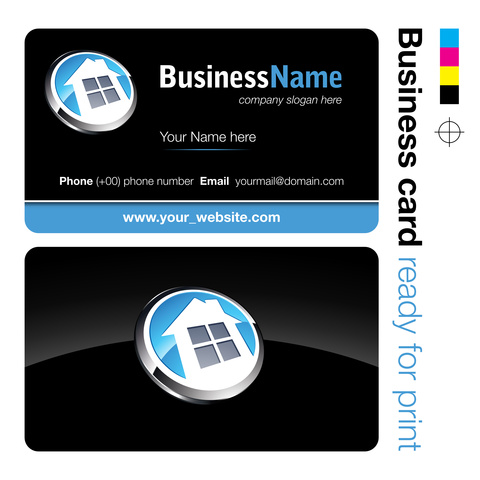
A black background can occasionally be effective for construction business cards, but my personal preference is a white background as it makes the text easier to read.

Here’s another example of what not to do.  I recently traded cards with a local lawn maintenance business operator and had to bite my tongue to keep from laughing because his was a complete joke.  To his credit, the cards had obviously been made by a printing company and were printed on standard white stock (as opposed to a cardboard box), but the graphics and text were totally absurd.  The graphic was of a plain stick-figure just standing there and waving.  It looked like something that a preschooler would draw on a rainy afternoon.  Can someone tell me what that has to do with landscaping or mowing?  At the very least, could he not have found an image of a stick figure that was actually mowing a lawn?  The text was even worse, if that’s even possible.  It was simply his name, phone number, and a brief list of what services he provides.  Let’s just start with the fact that there were at least two misspellings on the card.  Yes, you read that right.  Secondly, there was absolutely no mention of what his qualifications were or if he was even insured.  Finally, he chose a font that was so silly that it really did look like his little kid designed the card for him.  The card as a whole was a complete disaster and I felt bad for him that he was handing it out to prospective customers and thinking that it was actually helping him to grow his business.

How To Design Contractor Business Cards For Maximum Impact

So now that I’ve mercilessly trashed a few of my fellow local contractors you’re waiting for me to get around to actually telling you how business cards for construction should look, right?  Well, let’s start with the graphic (and, yes, I do think it’s a good idea to have one).  Keep it to less than half the size of the card face.  It should be either a high-resolution replication of your business logo (you do have one of these, right?) or an image of a project that you worked on that turned out particularly well.  A before and after photo on the back side couldn’t hurt, either.  If neither of these is a possibility then just leave it blank.  Blank is better than a corny cartoon graphic or, worse yet, a darn stick figure.

Make sure the text is spaced out well and easy to read (white background is best), and choose a font that looks professional and neat.  Skip the bubble font, okay?  Your card should have your name and title, your company’s name, address, and phone number, your cell phone number and personal or business email, and your company’s website address.  It should also tell people what you do and what your qualifications are.  Finally, it should spell out for nervous nellies that you are fully licensed and insured.  If there’s room put any awards on there that you might have earned from Angie’s List or the like.  That’s it!  Try to keep descriptions short and to the point.  You want enough information on the card that it is a helpful resource for potential clients but you don’t want so much that it looks like a darn dictionary.  Remember that a lot of the people that hire you will be older and may have trouble reading very small print.  The bottom line is trust.  Look at your card honestly and ask yourself how it looks to complete strangers.  If it looks like crap then start over.  There’s no shame in admitting that you made a mistake and need to correct it.

Opt For High Quality Materials When Your Contractor Business Card Is Printed

The last piece of this puzzle is the actual card material itself.  When you order your cards they will ask if you want certain upgrades and features.  For the most part you’ll want to say yes down the board.  Extra thick stock?  Say yes.  Glossy face?  Say yes.  Picture on the back?  Say yes.  They may even try to sell you a unique card material like wood, plastic, or metal, and in some cases this makes sense.  For example, if you run a log siding installation company then I think it would be totally appropriate to order wood cards.  True, all these upgrades will cost you a few more bucks but what’s a few bucks when there’s thousands of dollars worth of business on the line?  Do you really want to risk losing a $15,000 roof job because you were so worried about spending an extra five dollars on a business card upgrade?  Think about it, folks.  When you hand someone your card you’re saying that it’s an accurate reflection of who you are and how seriously you take your business.  If your card looks like junk then people will assume your business is junk.  Spend just a little more time and a little more money on those construction business cards and I assure you that they will pay for themselves thousands of times over.

{ 4 comments }

If you’re like a lot of this site’s visitors then you’re here because you want to learn how to become a contractor, but you’re also unsure if this is the best time to be starting a business.  With all of the current economic problems you might be thinking that this is a terrible time to become a full-time contractor.  You might be scared that after dumping money and time into getting your little company off the ground that it will fall flat on its face because everyone is telling you that consumer spending is down, bank lending is down, and the end of the world is near.

My response to these doubts?  Simple.  Stop making excuses and get going already!

Many people have dreams of starting their own contracting or service business but in reality few of them ever actually break free from wage slavery and become business owners.  Why?  “Because it’s too hard.”  “It’s too complicated.”  It’s too time-consuming.  It’s too risky.  It’s too scary.  I’m not smart enough.  The economy is tanking.  I might fail.  I might not have a consistent paycheck.  Blah.  Blah.  Blah.

If you want to do it then do it.  Timing should be the least of your concerns.  But just for the record, this could actually be a great time to start your small contracting business on the side and see what happens.  Why?  Because most people are so fearful right now to make any investments in themselves or their businesses that it has created some wide-open opportunities for the rest of us to make inroads in our local markets.  While the other would-be entrepreneurs in your community are cowering in fear and unwilling to part with their so-called “secure” 9-5 job, you’ll be out there getting work, building a brand, and forming professional relationships.  The result is that a few years from now when the economy is booming again you’ll already have the foundation in place for record growth while everyone else is just getting started.

Be a contrarian and reap the rewards down the road.  Those who are most successful in the long-run are often the ones who become aggressive when others are running for the hills, whether it be in real estate, stocks, or entrepreneurship.

Just get going.

{ 2 comments }

There was an interesting article in the New York Times yesterday that makes mention of the fact that many plumbing contractors/owners these days defy the typical stereotypes, both in business savvy and earnings.  Money quote:

“Long the object of putdowns and distasteful humor — Mr. Breslaw cited the classic “If you don’t go to high school, guess what you become?” — plumbers are, in many cases, exceedingly well paid. Mr. Breslaw said that one of his top men “clears two, maybe two-and-a-quarter” every year. He even paraphrased Einstein: “If I had my life to live over again, I’d be a plumber.”

Keep in mind that this is an employee earning over $200,000 a year.  Can you imagine how much the owners of the company are making?  The public often looks at contractors or service providers as uneducated, poorly-paid hacks, but this couldn’t be further from the truth for millions of sharp, nice-car driving, no-debt carrying small business owners all across this country who make a lot of money.  You can get mad about these false assumptions or you can accept them and understand that they set the stage for less competition and better opportunities for you to get in the game and start taking a piece of the pie.

{ 0 comments }

No matter if you plan on becoming a general contractor or a window cleaner, in the early days of your business you’ll be going toe-to-toe with big, established companies and maybe even some national chains or franchises.  You might be inclined to think that this gives you a disadvantage, and in some ways this is true (they can outspend you in advertising, for one).  However, it also gives you some distinct advantages over the big boys.  Here are some ideas for how to give the behemoths a run for their money.

  1. Play up your “hands-on” role as an owner-operator.  People will be impressed that you, the business owner, took the time to provide a detailed, in-person estimate.  They’ll be doubly impressed that you make a point of being on site for all jobs.  This will go miles in assuring homeowners that the job will be done correctly and with quality in mind.  Compare this with a franchise that sends barely-qualified salespeople and laborers out to do the dirty work and you can see how this is a major advantage for you.  Don’t forget to make this distinction clear when you meet with the customer that first time.  In my company’s early days we beat out larger, franchise operators time and time again with this technique.  Oh yeah, and make sure to send out that signed thank you letter after job completion (you’d be surprised by how many of the bigger companies don’t bother to do this).
  2. If your business is “family owned and operated”, say so.  It gives potential customers the impression that the business is generational and that you’re true, skilled craftsmen.  It also lends a sense of accountability because people know that while a new hire off the streets might be more inclined to cut corners or act stupid when the boss isn’t around, a relative of the owner is less likely to do so.  There’s more pride when the family name is on the line, and people know this.
  3. Many people would rather give their money to a local, scrappy company than to a faceless corporation that doesn’t give a damn about the community.  It makes homeowners feel good that by hiring you they are, in effect, keeping the wealth “in town”.  You can really leverage this advantage by doing all you can to support local events that allow for marketing opportunites.  Sponsor a little league team, do free work for charitable causes, or offer discounts to homeowners within a certain radius of your home or office.  I’ve had customers tell me that my business’ proximity to their home was the single biggest motivating factor in awarding me the job.
  4. People root for underdogs.  You’ll find that a lot folks will respect your desire to build a business from scratch, and it makes them feel good to help make your dream a reality, especially in it’s early stages.  It’s important to note that you shouldn’t make a point of telling customers how new or small your company is, but don’t lie about it, either.  If they know or come to find out that you are a newer business most people will still give you a shot if you look and act professional.  Lack of experience need not be a roadblock if you can demonstrate superior knowledge, organization, and hunger for success to the potential customer.  If given the choice between a friendly, eager business owner who’s been around one year and an apathetic, established company that’s set on “cruise control”, I think most consumers would choose the former.
  5. Your small business can schedule and perform work more quickly.  Many of your customers will put off home improvement and maintenance jobs until the last minute, and so your ability to work them into the schedule quickly will often prove advantageous.  Often times the big companies are booked out for a month or more, and this gives your newer, less overloaded company a great opportunity to snag a job from under their feet by being able to get to it sooner.  Don’t be embarrassed that you’re only booked out for a week or two – look at it as one more way to gain ground on your bloated competitor.

So there you have it.  Five ways to take your larger competitors to the mat.  Can you think of other ideas?  If so please comment below.

{ 2 comments }